3D Industrial Visualization: Innovations in Technical Product Presentation
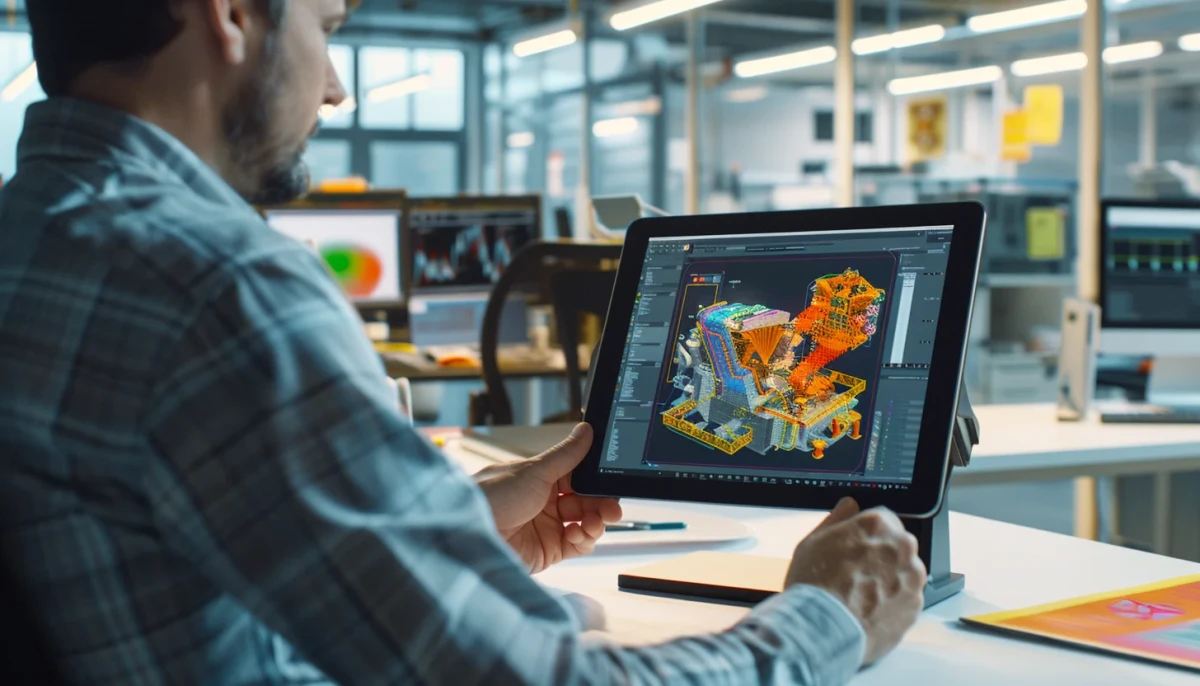
In the modern business world, 3D industrial visualizations have become an indispensable tool for product managers and marketing professionals. They offer industrial companies the opportunity to present their physical products in an innovative and appealing way.
Because even companies in mechanical and plant engineering, whose target groups are usually B2B customers, increasingly need to market themselves broadly and are therefore active on digital sales channels. One-to-one communication has increasingly become one-to-many communication.
This means, not least: Convincing visually and communicatively. Here, 3D industrial visualizations are a goldmine for marketing and sales.
This blog post highlights the importance and benefits of 3D industrial visualization and shows how technological advancements support this industry.
The Importance of 3D Industrial Visualization
Increasing Product Perception
3D industrial visualizations enable companies to display their products with unprecedented detail. Through photorealistic representation, potential customers can view the product from all angles and get a comprehensive understanding of its features and design. This immersive experience improves product perception and increases the likelihood of a purchase.
Improving Sales Strategies
Integrating 3D visualizations into sales strategies has proven to be extremely effective. By presenting products in a realistic and appealing manner, marketing teams can capture the attention of potential customers and pique their interest. Additionally, 3D models allow for flexible adaptation of the presentation to different target groups and markets, significantly increasing the efficiency of sales strategies. This even makes completely digital and virtual product presentations possible.
Technological Advancements in 3D Visualization
Photorealistic Representations
Thanks to the latest technologies in 3D industrial visualization, products can now be rendered with a quality that is almost indistinguishable from real photos. These photorealistic representations use advanced rendering techniques to simulate materials, lighting conditions, and shadows in detail. A good example of this is our article on CAD visualization, which explains the transformation of CAD data into impressive visualizations.
Interactive 3D Models
Interactive 3D models go a step further by allowing customers to virtually explore the product. By interacting with the model, users can test functions, move parts, and experience the product in a way not possible with traditional 2D images. This interactivity creates a deeper understanding and stronger connection to the product.
Virtual and Augmented Reality
Virtual Reality (VR) and Augmented Reality (AR) are other exciting developments in 3D industrial visualization. VR allows users to immerse themselves in a completely virtual environment and experience products in a realistic setting. AR, on the other hand, overlays digital information onto the real world, allowing customers to see and test the product in their own environment. These technologies offer unique opportunities to improve the customer experience and facilitate purchasing decisions.
3D Industrial Visualization and Industry 4.0
The Role of 3D Visualization in Industry 4.0
Industry 4.0 represents the fourth industrial revolution, characterized by the digitalization and networking of production processes. In this context, 3D industrial visualization plays a central role. It enables seamless integration of design, production, and marketing by creating digital twins that represent real products in a virtual environment.
Benefits of Integration into Industry 4.0
Integrating 3D industrial visualization into Industry 4.0 offers numerous advantages. Digital twins can be updated in real-time to reflect the current state of a product or production facility. This facilitates monitoring, maintenance, and optimization of production processes. Additionally, simulations can be conducted to test product performance under various conditions without having to produce physical prototypes. More information on this topic can be found in our article on PLM and CGI.
Practical Examples and Future Prospects
In practice, companies that have integrated 3D visualizations into their Industry 4.0 strategies have seen significant improvements in the efficiency and flexibility of their production processes. The ability to integrate data from various sources and visualize it in a virtual environment enables better decision-making and faster response times to market demands. The future development of these technologies will further expand the possibilities of Industry 4.0 and unlock new potential for product visualization.
Application of 3D Industrial Visualization in Various Industries
Automotive Industry
In the automotive industry, 3D industrial visualization already has a firm place. Manufacturers use it to present new vehicle models before their market launch. These visualizations allow customers to view the vehicle from all sides, look inside, and even change color selections. This detailed and realistic representation arouses customer interest and increases their willingness to buy.
Consumer Goods Industry
3D visualization also plays an important role in the consumer goods industry. Companies use it to present their products appealingly and to support the market launch of new products. A good example of this is our article on how 3D rendering improves prototyping and product design. By using 3D models, product designers can work faster and more efficiently, leading to shorter development times and more cost-effective production processes.
Mechanical and Plant Engineering
In mechanical and plant engineering, technical visualization enables a better representation of complex products. Through detailed 3D models, engineers and customers can better understand the functioning and structure of machines. These visualizations are particularly useful for explaining technical details and training employees. Furthermore, they can be used to review and optimize designs before actual production.
From Practice
Successful Implementations
There are numerous examples of successful implementations of 3D industrial visualizations. Companies from various industries have significantly improved their marketing and sales strategies through the use of this technology. Here are some references from the 3D agency RenderThat: